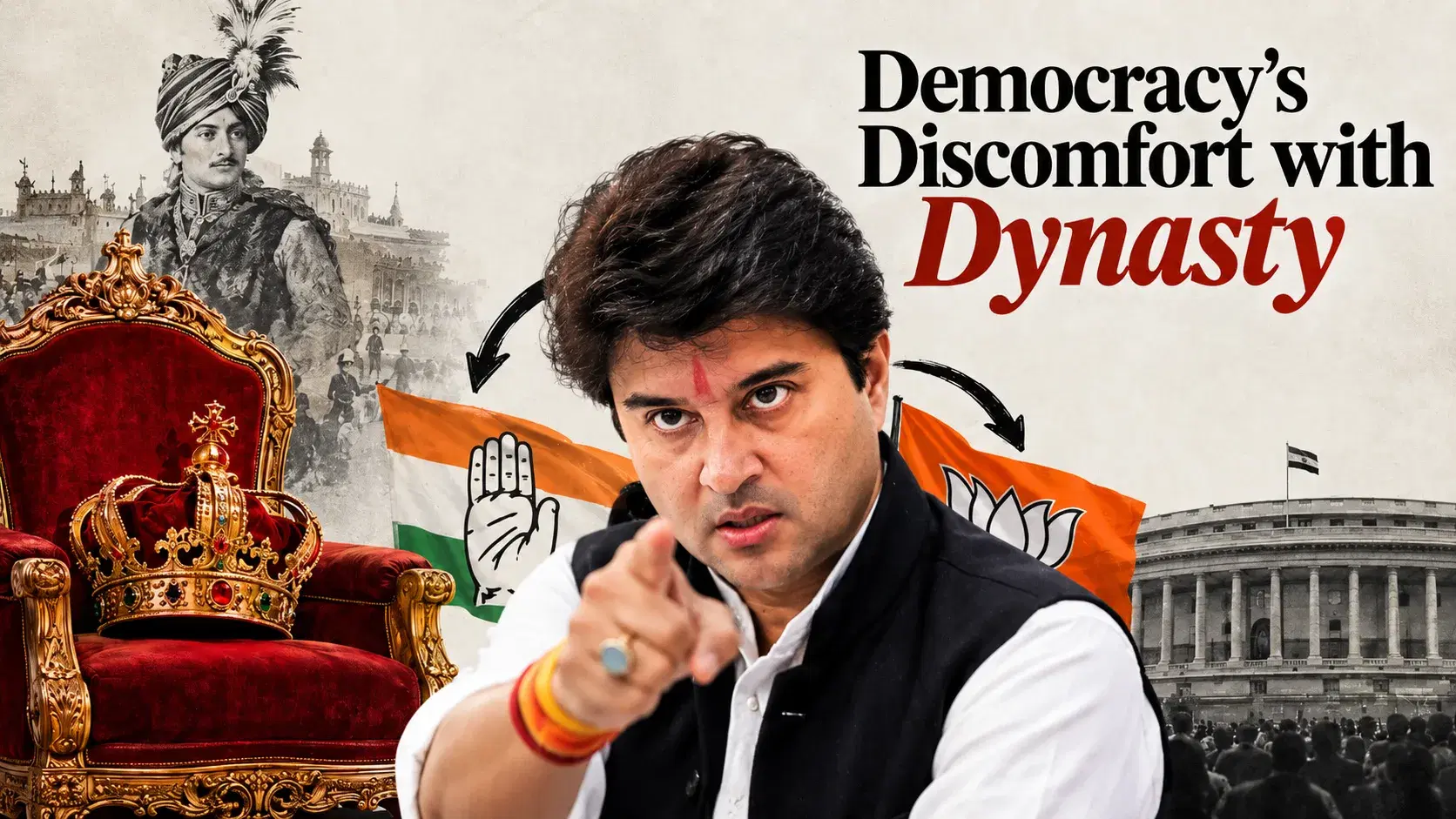
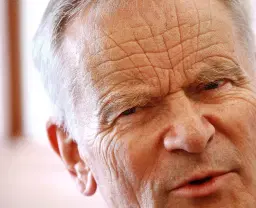
Democracy's Discomfort with Dynasty: The Case of Jyotiraditya Scindia
Jyotiraditya
Scindia carries himself like royalty without a kingdom — the scion of Gwalior's
erstwhile royal family, still performing monarchy inside a republic. The latest
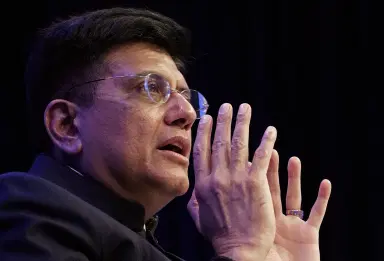
evidence: a video that went viral days ago showing him snapping at a voter who
threatened to withhold his vote over unbuilt roads. "Never use this
language in front of me," he retorted, finger pointed at the disgruntled
man. The clip drew widespread backlash and fits a pattern: veteran politicians
touching his feet — and even his son Mahaaryaman's — as though deference to the
bloodline were simply owed.
Politics
may be the only profession left in India that lets you live like a monarch
while calling it democracy.
Jyotiraditya is the third generation of a family that
has treated power as inheritance: his grandmother Vijaya Raje Scindia and
father Madhavrao Scindia were towering political figures in their own right,
and both, like him, switched sides at opportune moments. His defenders call
this pragmatism. It's also, conveniently, seems a family tradition.
Vijaya
Raje began with the Congress in 1957 and defected in 1967 after falling out
with Chief Minister D.P. Mishra. Madhavrao entered politics under the Jana
Sangh — the BJP's forerunner — before crossing over to the Congress.
Jyotiraditya's own defection in March 2020 brought down the Kamal Nath
government in Madhya Pradesh overnight.
Two
decades of being one of the Congress's loudest anti-BJP voices vanished the
moment he switched sides — condemnation became praise. The timing tells the
real story: the break came soon after he lost his family bastion of Guna in the
2019 Lok Sabha elections, was passed over for Madhya Pradesh Chief Minister in
favour of Kamal Nath, and was denied a face-saving Rajya Sabha seat. When the
party stopped serving him, he stopped serving the party.
None
of this makes him responsible for his ancestors' choices, and holding him to it
would amount to guilt-by-bloodline rather than argument. But the family history
is worth knowing and weighing — if only to ask whether it repeats itself, in
some form, generation after generation. Are conviction and loyalty tradeable on
the altar of pragmatism and opportunism?
During
the 1857 Rebellion, as Gwalior grew mutinous, Jyotiraditya's ancestor Jayajirao
Scindia sheltered British political agent Major Charters Macpherson and helped
evacuate him and other British officials to Agra. A year later, in June 1858,
when Rani Lakshmibai and Tatya Tope's forces stormed Gwalior, most of
Jayajirao's own troops defected to join them, forcing him to flee and seek
protection from his British friends in Agra — protection that later helped him
reclaim his throne after Lakshmibai's death in the British counter-offensive.
That episode passed into folklore, memorialized in Subhadra Kumari Chauhan's
poem Jhansi Ki Rani, which singles out the Scindias by name as the ones
who abandoned their capital to side with the British. And this help persisted British rule in India for another 90 years.
People's
memory is short, and I don't wish to hold him responsible for the acts of his
ancestors. But somebody should tell him: he is no maharaja. It's high time he
and his clan understood that Bharat is a democracy, and at best he is just
another opportunist politician. This hangover of royalty — heir to the
'Jayadratha' of India's first war of independence — should end, once and for
all.