
MANZOOR ANZWAL: FINDING THE FAQEERA
I
was lost in the twisty lanes and bylanes of Anantnag while searching for the
residence of Manzoor Ahmad Anzwali, a Kashmiri Sufi singer, poet and
instrumentalist. A stranger, it seemed destined, led me to the doorstep of
Manzoor's grand, double-storey house, and even knocked on the door for me.
We were welcomed into the living room by his son. After a while, Manzoor arrived. This was our first meeting, yet I felt a profound connection with him.
Manzoor
is part of a musical lineage that extends for generations — like a bloodline.
But lineage doesn't offer a livelihood. When Manzoor decided to do what his
ancestors had spent their lives doing, true to his lineage, he was discouraged
by his parents and father-in-law. Manzoor was adamant, so were they. He was
disowned by them. His survival as an artist has been nothing short of a street
fight.
"They
didn't even give me an empty plate when they asked me to leave the house. My
father-in-law was categorical: either you stop singing or leave my daughter. I
left neither and walked away," he narrated his story.
Manzoor
never got a formal education, yet, in sync with music, he writes, composes
and sings in many languages — Kashmiri, Urdu, Persian, and Arabic. For many
years, he recited self-composed verses into the ear of another famous singer,
Ghulam Ahmad Bhat, who couldn't read, and he, in turn, would sing those verses
in mehfils, or spiritual gatherings.
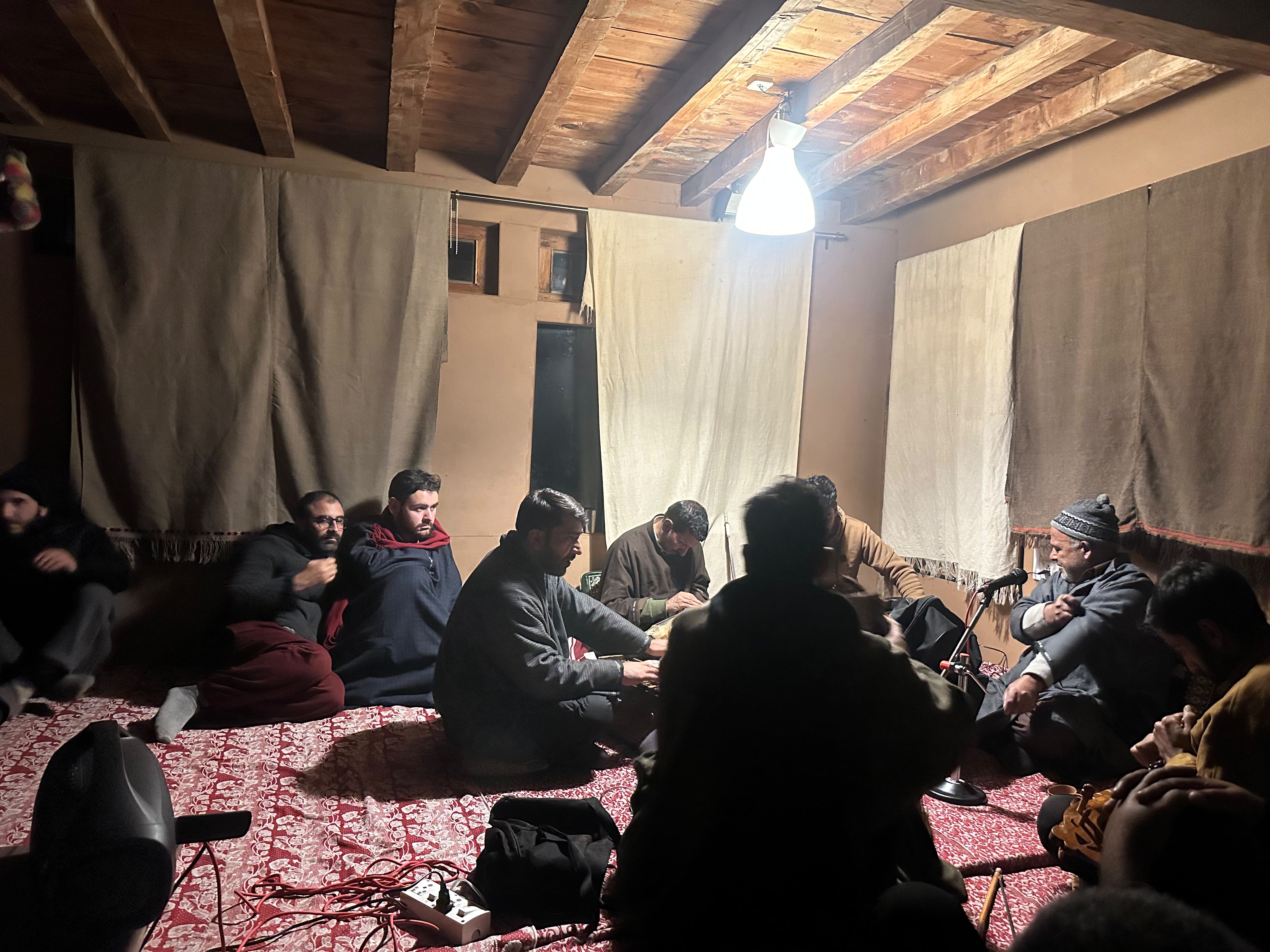
One
evening in 1996, the crowd was patiently waiting, the air thick with
expectation, and Ghulam didn't show up to perform. The master of ceremony, Peer
Saleem Sahab (Manzoor's spiritual mentor), directed Manzoor to play and sing.
He
did well, and since then has been performing for more than 30 years. He has
also performed at the dargah of Hazrat Nizamuddin Auliya in Delhi. To perform
is a spiritual experience for him — he gets immersed in the verses he has set
to tune.
After
looking intently at me for a while, he recited an Arabic verse to explain his
relationship with music. It translates to: Despite the vastness and
complexity of the universe, everything is in precise, harmonious balance, with
no structural defects or contradictions. Then he paused to add, "My
instrument is a part of that balance."
I
was treated to a feast of tea, biscuits, cookies, and namkeen — despite my
insistence that it wasn't necessary. His spiritual guide had mandated
hospitality: "No one leaves my house without being fed, even if it's just
a glass of water."
Manzoor
is a self-made musician. Without family support, and as a traditional artist
bearing the torch of Kashmiri literary and musical tradition, he — like others
with a profound connection to the language — is struggling. Society, at best,
is indifferent to their talent and craft. They face haunting uncertainty, an
existential crisis at every step.
Technology,
finally, came to Manzoor's rescue. Thanks to social media, his reels went
viral, popular among the youth; his YouTube videos routinely get more than a
million views. He has made traditional music chic with the next generation of
Kashmiris. An online celebrity — that's what Manzoor has become.
He
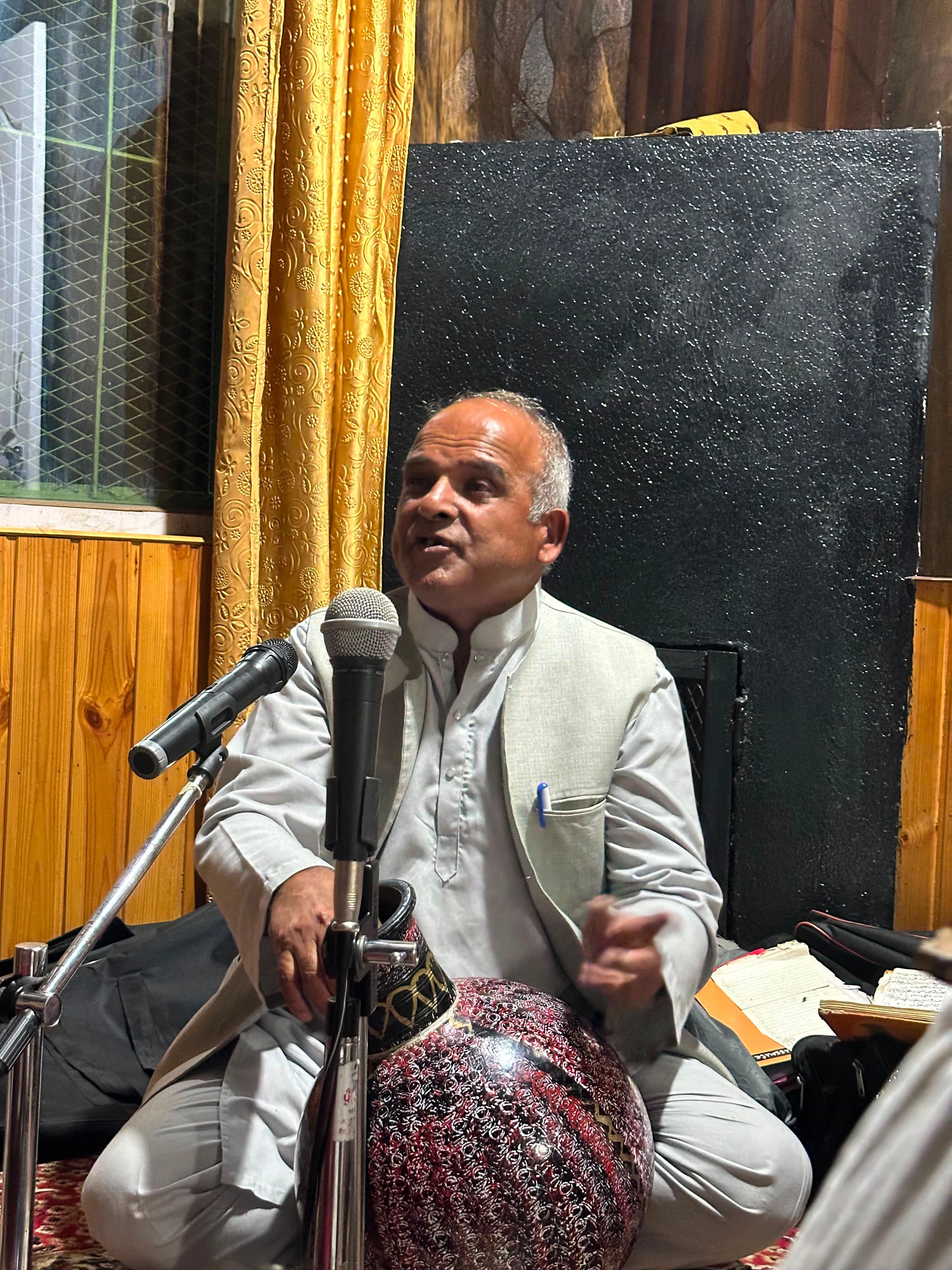
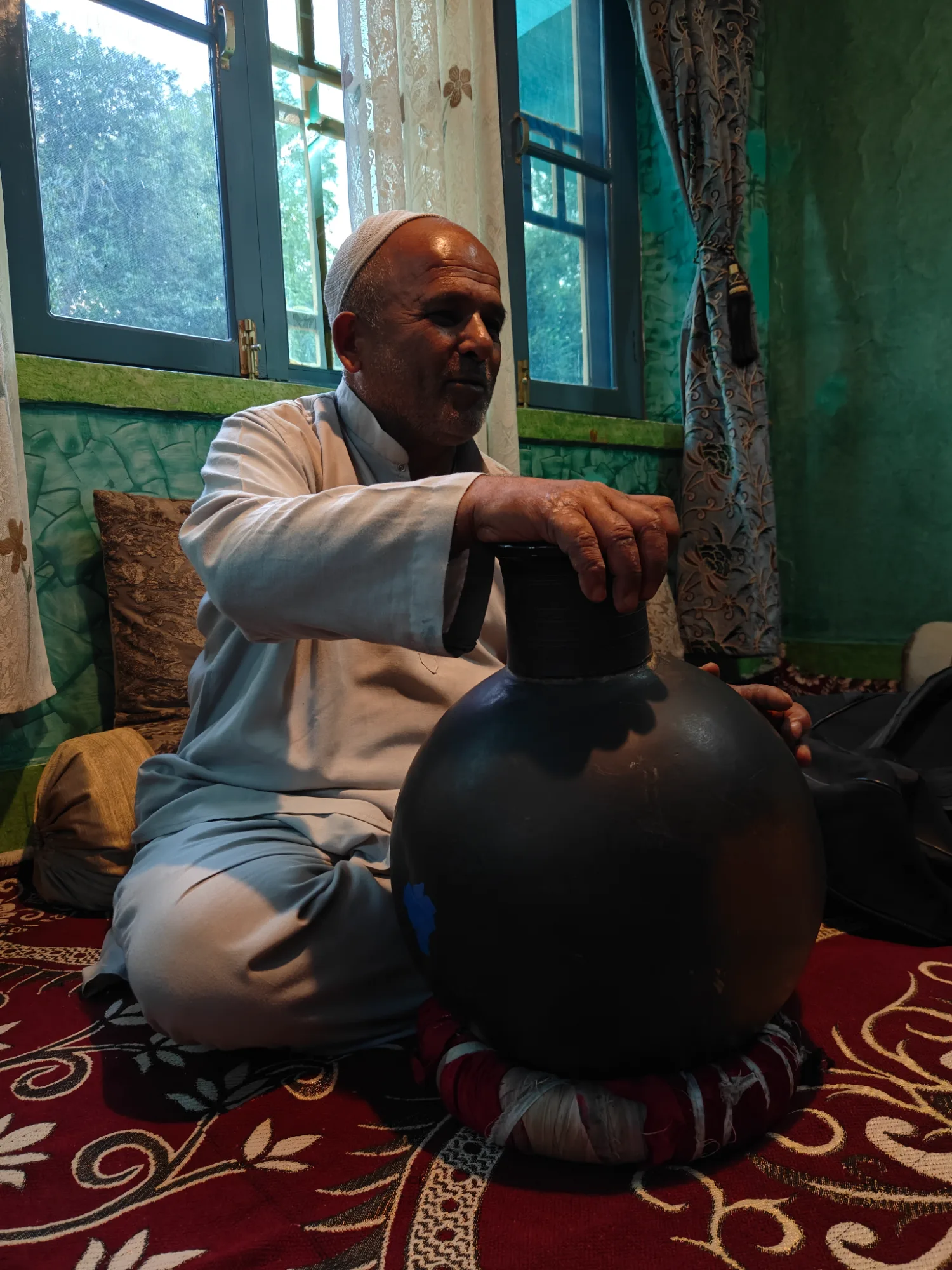
had to perform in a few hours; it was time for me to leave. Just then, Manzoor
fetched a nout — a local traditional percussion instrument made of clay
— and played a capriccio to show me how it's done. It was a lovely way to say
goodbye.
Manzoor
may not have had a plate to eat from, but for decades, he has been quenching
the musical thirst of thousands of Kashmiris.