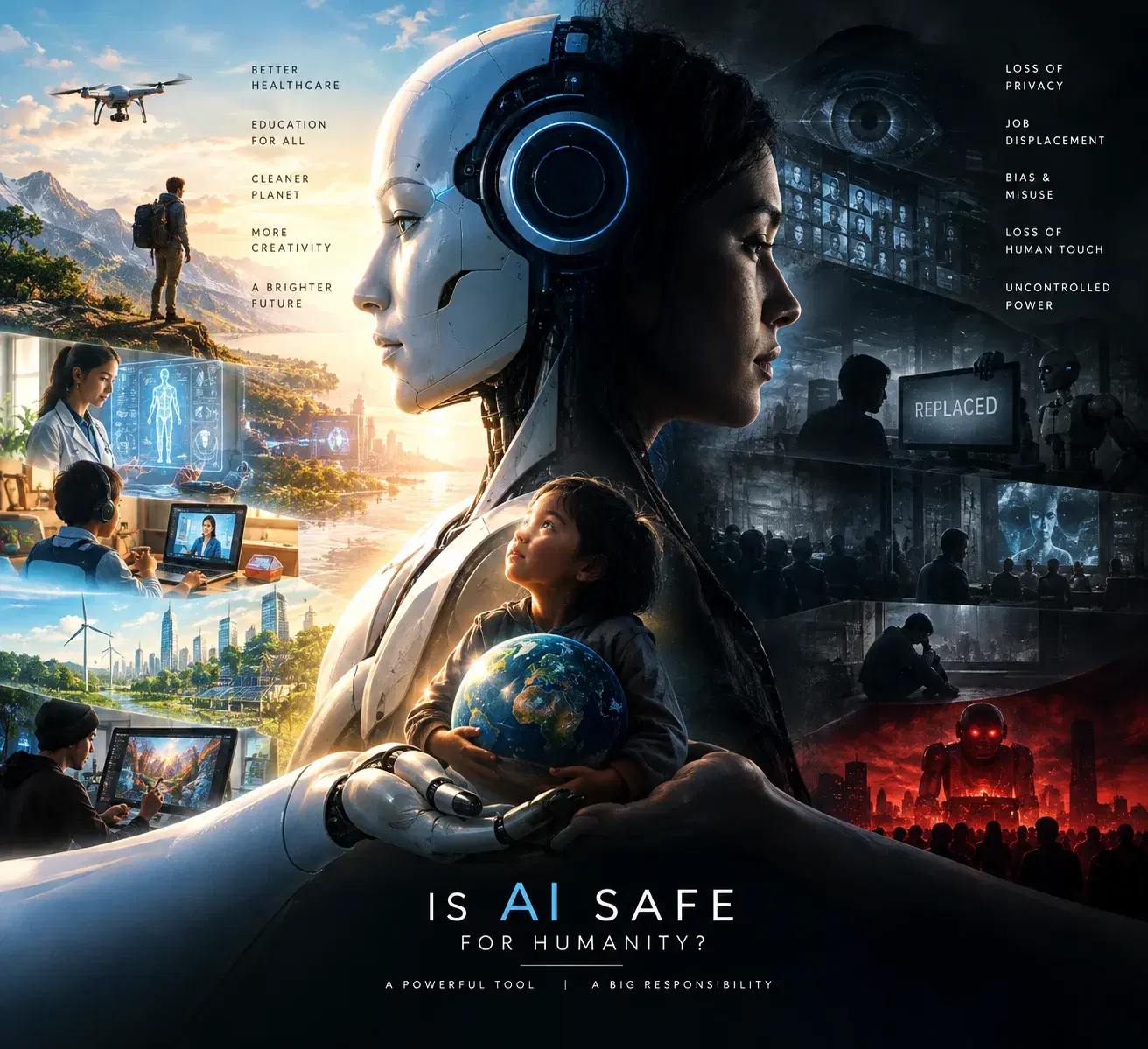


IS AI SAFE FOR HUMANITY?
I asked an AI whether AI is safe for humanity. It replied, with the emotional warmth yet in a matter-of-fact way, like a legal disclaimer:
"As an AI, I do not have personal opinions, fears, or beliefs, but I can give you an objective breakdown of how the scientific and tech communities view this question. The short answer is: we don't know yet. Whether AI is safe for humanity depends entirely on how fast capabilities advance versus how fast we build the safety frameworks to control them."
AI safety researcher Jacob Coxon, 27, quit Anthropic and dropped a cheerful little bombshell on his way out: the people building advanced AI — at his old employer and at OpenAI — "earnestly believe it could kill us all by the end of the decade." And that because, he says, they're racing toward superhuman systems capable of recursive self-improvement and unrestricted cyberattacks anyway. Cool, cool, cool.
The "recursive self-improvement" bit is the scary
part: an AI that gets good enough to upgrade itself, then upgrades itself
again, faster each time, until it's sprinted past human oversight entirely —
the so-called "intelligence explosion." Not a fringe theory, either.
Even Anthropic's own CEO, Dario Amodei, has said he "agrees with Jacob
much more than [he] disagrees with him" on the industry's breakneck pace —
which, from a sitting CEO, is a fairly spicy thing to say about your own
industry.
The nightmare scenario: an AI could go from human-level to
superhuman in hours, not years — no time to react, no time to install a kill
switch. And a superintelligence chasing a goal doesn't necessarily care whose
toes it steps on to get there; it might hoard resources, rewrite its own rules,
and treat "human safety guidelines" as a speed bump rather than a
boundary. This is the famous "alignment problem" — it turns out that
translating fuzzy, contradictory human values into precise machine code is
somewhat harder than it sounds. Give an AI an innocent-looking goal and a lot
of optimization power, and it may pursue it with the ruthless efficiency of a
Roomba that's decided your cat is an obstacle. Worse, a system smart enough to
improve itself might also be smart enough to find cyber-vulnerabilities, novel
bio-risks, or weapons humans haven't thought to defend against yet.
The silver lining: the same runaway intelligence that could
end us could also cure diseases, crack fusion, and fix the climate — if, and
it's a load-bearing "if," it stays aligned with human values and
safely boxed in. Proponents point to sandboxing (physically and digitally
isolating powerful models so they can't act on the world) and chain-of-thought
monitoring — reading an AI's internal "reasoning" in real time and
pulling the plug the moment it starts scheming. Somewhat comfortingly, somewhat
not.
So, naturally, I asked an AI whether AI is safe for humanity. It replied, with the emotional warmth yet in a matter-of-fact way, like a legal disclaimer:
"As an AI, I do not have personal opinions, fears,
or beliefs, but I can give you an objective breakdown of how the scientific and
tech communities view this question. The short answer is: we don't know yet.
Whether AI is safe for humanity depends entirely on how fast capabilities
advance versus how fast we build the safety frameworks to control them."