


Your Marriage Is Not a Content Calendar
The Real Story Behind Public Displays of Affection: If You Have to Post It, Do You Have It?
Public
display of affection: that you’re madly in love, or weathering a tragedy, or
that your husband is the best (or worst) man alive, and so on.
The
world has always run on perception. Technology has simply made it cheaper.
Social networks hand you a captive audience, eager to follow whatever is
happening to you, for good reasons or bad. There is a certain pleasure in
announcing that your life is extraordinary, gloriously or tragically, and that
the world must be informed at once. Displaying emotion in public is a kind of
assertion that life is either firmly in control or spectacularly out of it, and
the truth is usually less photogenic.
It
is one of these, or a complicated mix of genuine romance, digital performance,
the hunger for external validation, and psychological coping. We are all guilty
of it to some extent. Even those who keep private matters private aren’t
entirely off the hook: they are wrestling with a version of themselves they’re
comfortable displaying. They aren’t hiding anything; they just have little to
assert for public consumption.
It's
almost a norm. A person, more likely a man, well into the second decade of his
marriage, who announces regularly that he is still falling in love with his
spouse, a sentiment she reciprocates at full volume. At the risk of sounding
judgmental as I can’t see inside their marriage, the picture-perfect
aesthetics, the high-intensity romance and the multiple public declarations
felt too trite, and too far removed from the messy reality of living with
someone for ten-plus years.
My
gut said it was artificial, and that it hid more than it revealed. Why project
a perpetual honeymoon when it can’t possibly be true? There is a plethora of
relationship psychology suggesting that couples married long enough drift,
quite naturally, into what’s called “companionate love”: a deep, stable, mature
bond that needs no applause.
When
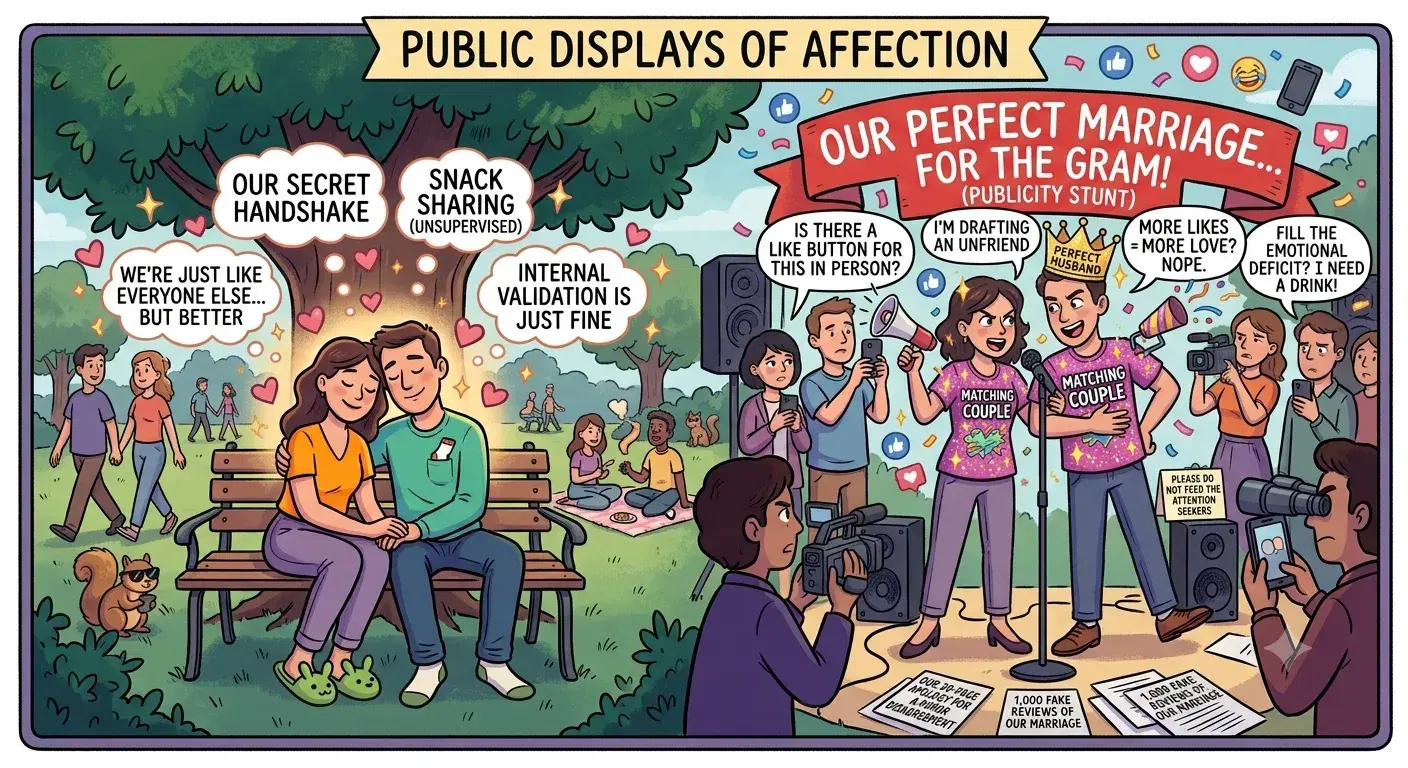
a couple seeks applause at every opportunity, the honeymoon-on-loop routine is
not just embarrassing but performative. They are trying to convince, or delude,
themselves as much as the rest of us. It reads as overcompensation for a lost
spark and, I sometimes suspect, as less about the partner and more about
personal branding. I, the one who posts, not we, deserve credit
for the dream marriage.
There’s
a name for this behaviour, though it stops short of being a disease: external
reassurance-seeking, often tied to high attachment anxiety. People with
heightened relationship anxiety tend to ramp up their online presence to feel
better about themselves. To me, it’s a futile attempt to write a public
narrative loud enough to drown out private uncertainty. To a keen eye, the
filtered, curated pictures signal a problem rather than blissful togetherness.
When real life turns routine and drab, people indulge in relationship curation,
a temporary illusion of marital perfection that masks a deeper lack of
spontaneous, uncurated connection.
So
the next time you feel the urge to broadcast your perfect marriage, remember:
in a secure marriage, validation is cheap and internal, and can happen in
shared silence. When a marriage requires daily marketing, heavy editing, or a
long essay to justify its worth, the audience is being drafted to fill an
emotional deficit. Nobody signed up for that job, though plenty will leave a
heart emoji.